No Asteroids Ship Upgrades: Cargo, Compactor and Repair
Cargo capacity, the six-level Compactor, the $500 repair station and the suit upgrades worth buying — with a straight buy-or-skip table.
Ship upgrades are where a No Asteroids run stops being about survival and starts being about throughput. The first few purchases keep you alive — air, a bigger hold, a repair station. After that, every upgrade is a bet that the extra capacity will pay for itself before the ninety days run out.
This page sorts the upgrades by what they actually do, gives the published prices, and marks the ones most runs should skip.
What can you upgrade on the ship?
Four things: cargo capacity, the Compactor, the repair station, and the modules you can sell back when a purchase stops fitting the run. The suit upgrades that change how you move — boots that anchor and a jetpack with its own upgrade path — are bought alongside them and covered below because they change the same shift.
| Upgrade | Cost | Buy or skip | Why |
|---|---|---|---|
| Repair station | $500 (community-reported), once per in-game year | Buy, week one | Five bonuses for the price of a Sledgehammer |
| Cargo capacity | Not published | Buy when the hold fills before the air bar | Direct ore per shift |
| Compactor | About $13,230 across six levels (community-reported) | Buy mid-game, level by level | Packs more ore into the hold you already have |
| Boots anchor | Not published | Buy if you work vertical ground | Stops the fall that ends a shift |
| Jetpack upgrades | Not published | Buy after air and cargo | Movement, not income |
| Selling a module back | Refund, not a purchase | Use when a build changes | Recovers part of a bad buy |
Only two of these have published prices. Anything quoted for cargo capacity, boots or the jetpack in the launch build is a screenshot value, not a fixed one.
How much cargo can you add?
Three capacity increases have been added since launch — two in 1.0.6 and another in 1.0.8 — and the base capacity is not published, so the honest answer is that the ceiling keeps moving. What matters is the pattern: the developers have repeatedly widened the hold rather than adding new systems.
Cargo is the cleanest upgrade in the game because it converts directly into money. Every extra unit of space is ore you would otherwise have left on the asteroid, and unlike digging speed it does not cost you extra air to fill.
The test for buying one is simple. If you return to the lander with a full hold and air left over, buy cargo. If you return with air gone and the hold half empty, cargo is not your problem — the air and oxygen guide is.
Is the Compactor worth $13,230?
It is worth it in the middle of a run, and a trap at the start. The Compactor runs to six levels and totals about $13,230, community-reported, which is more than twenty times the price of the repair station and roughly six and a half Drills.

The reason it is a mid-game buy is that its value scales with the volume you are already moving. Packing a small haul more tightly saves very little; packing a large one saves a trip, and a trip is a day. So the Compactor gets better exactly as your other upgrades get better, which is the opposite of the Sledgehammer, whose value is highest on day one.
The 1.0.8 change matters here. Since that patch the Compactor applies to the ship hold, which is the version of the upgrade most players are buying today. If you are reading launch-week advice that predates it, the numbers were measured on a different behaviour.
Is the repair station worth $500?
Yes, and it is the easiest upgrade decision in the game. The repair station is community-reported at $500, it can be bought once per in-game year, and it grants five bonuses. For the price of the Sledgehammer you get a set of permanent improvements that apply to every shift for the rest of the year.
The published material does not itemise the five bonuses, so treat the station as a bundle rather than a known quantity. What is clear is the economics: nothing else in the shop gives you five improvements for $500, and the alternative use of that money is a single tool tier.
The “once per year” clause is the part to plan around. In a ninety-day contract, a purchase that cannot be repeated should be made early rather than saved for a crisis — the earlier you buy it, the more shifts it applies to.
What do the boots and jetpack change?
They change how you move, which in a game built on vertical tunnels is closer to an income upgrade than it looks.
Boots anchor you to the asteroid once upgraded, which was added in 1.0.5. That matters on a vertical face where a slip costs you the climb back, and it makes steep routes viable for players who would otherwise stick to ramps. The jetpack has its own upgrade path, added in 1.0.4, and since 1.0.8 it recharges in mid-air — a change that turned the jetpack from a one-shot save into a movement tool you can use on the way down.
Neither is priced in the published material. Both should sit behind air and cargo in the queue, because neither one adds ore to the hold directly.
Can you sell modules back?
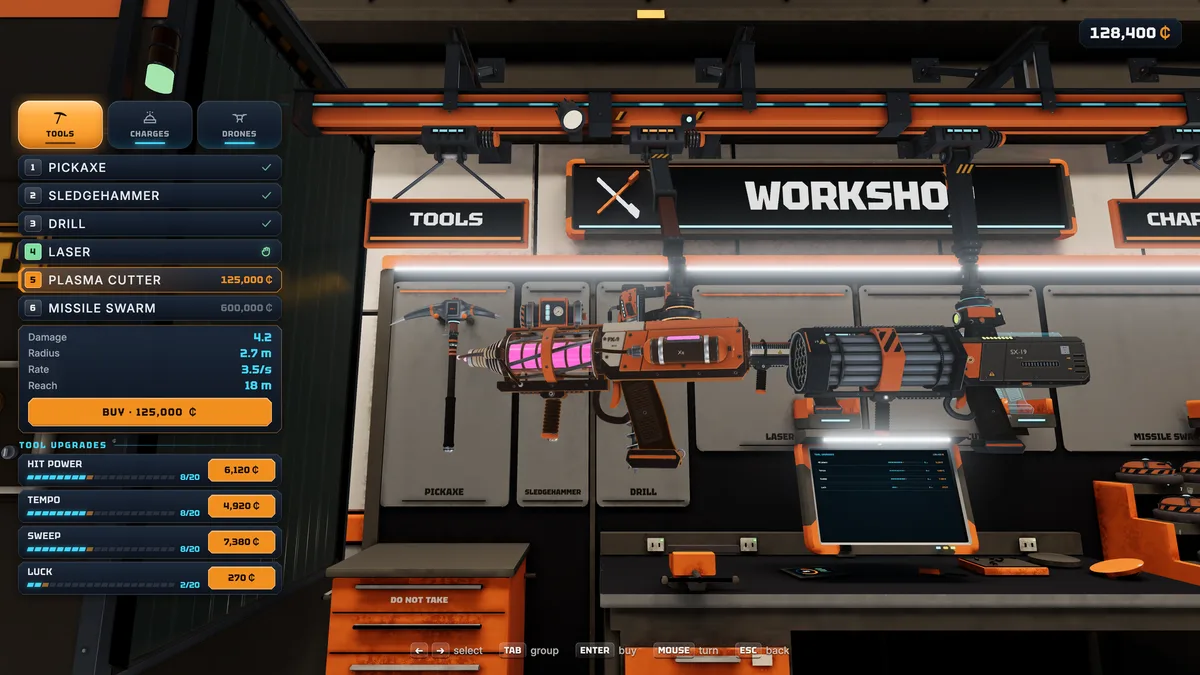
Yes, since 1.0.6, and modules are not the only thing you can sell. The workshop also takes tools back, and the two systems together mean a build is not permanent.
Selling back is a refund, not a free undo. That distinction matters when you are planning: it makes a speculative purchase survivable, but it does not make it free, so a module bought to test an idea still costs you the difference when you undo it.
The better use of the system is at the end of a run. If you are closing out a contract and a module is not going to earn its keep in the remaining days, selling it converts a dead asset into ore money you can spend on something that will.
When should you stop upgrading?
In the last ten days, stop buying anything that needs time to pay back. A cargo increase bought with eight days left is close to neutral; a Compactor level bought with five days left is a loss.
The exception is the repair station, because it is a one-off for the year and its bonuses do not expire with the contract. If it is still unbought late in a run, buying it is usually better than any other use of $500.
The upgrade order guide has the full ten-day plan and explains why air comes before digging speed and cargo comes before guns. If you are still choosing between the ship and the suit, the all tools guide makes the same case for hand tools: fix the bottleneck, then buy throughput.
Once the hold is bigger, the next question is what is shooting at the rock while you dig. The ship weapons guide covers the nine guns and the slot system, and the patch notes track the cargo and Compactor changes if you want to check what has moved since launch.
Gallery
FAQ
What is the best ship upgrade in No Asteroids?
How much does the Compactor cost in total?
Does the Compactor work on the ship hold?
Can you sell ship modules back?
Related Articles
guides
No Asteroids Beginner Guide: Your First Three Shifts
A No Asteroids beginner guide to the first three shifts: the 90-day contract, air and cargo limits, the tether, the ampoule and what to buy first.
progression
No Asteroids Daily Bonuses: Coffee, Ampoule, Shower and Plants
Every No Asteroids daily bonus explained: coffee, ampoule, microwave, shower, plants and massage, with effects, costs and the best morning order.
weapons
No Asteroids Collapsar: The Black Hole Gun Explained
The Collapsar fires a black hole into the rock and is the most expensive ship gun in No Asteroids. What it does, when to buy it, and why timing decides it.
Was this helpful?
Thanks for the feedback!