No Asteroids Hazards: Gas, Antimatter and Strange Matter
The four things in the No Asteroids asteroid that can cost you a shift: gas pockets, explosive Antimatter, Strange Matter and the dark rock you see glowing.
Most of what can go wrong underground is your own fault: too much depth, too little air, a shaft with no way out. Three things are not your fault, and they are the ones that turn a profitable shift into a crater. Gas pockets, Antimatter and the stubborn rock that survives both. Here is what each one does and what to do about it.
Which hazards actually threaten a shift?
Four things in the rock deserve a plan: gas pockets, Antimatter, Strange Matter and Dark matter. Only Antimatter is directly lethal to your cargo. Gas is a physical hazard, Strange Matter is a puzzle disguised as a hazard, and Dark matter is mostly a visibility problem worth knowing about.
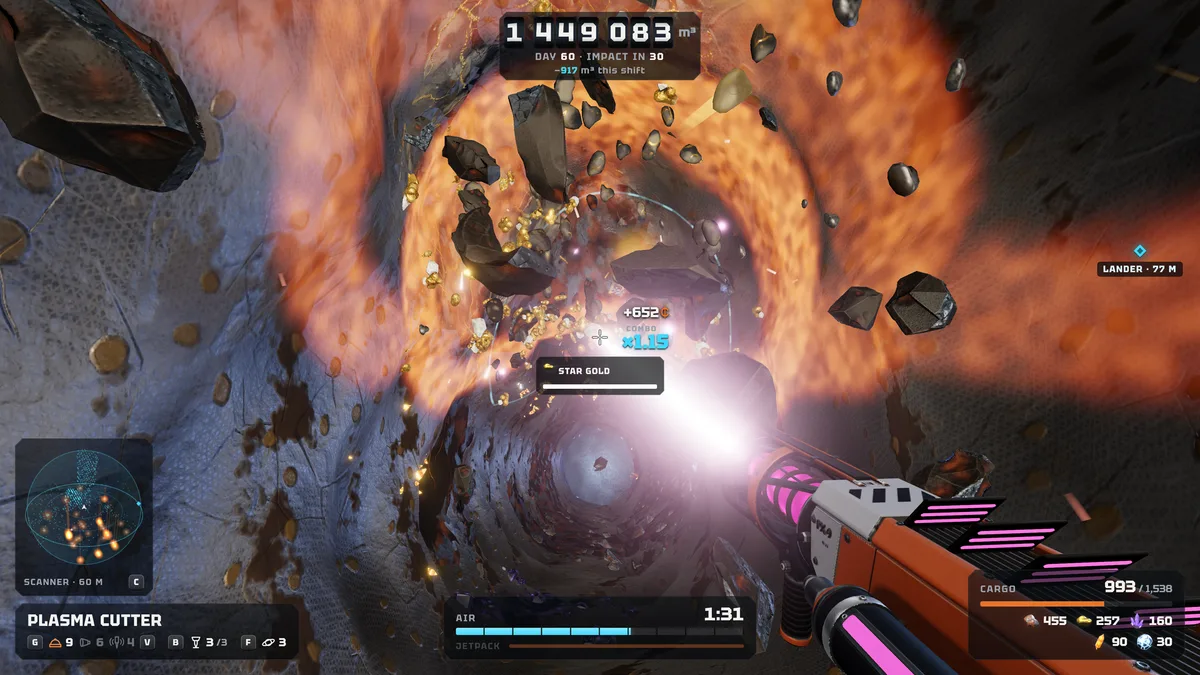
The unifying theme is that hazard damage is really air damage. Your air bar is the resource a hazard spends, because every knockback, detour and recovery costs seconds you cannot get back before the day ends.
| Hazard | What it does | What to do |
|---|---|---|
| Gas pocket | Hurts and knocks you back when breached | Approach from a distance, keep a clear exit, let drones work elsewhere |
| Antimatter | Explodes on a hand-tool or drone cut | Break it with a charge, singularity, mining rig or ship gun |
| Strange Matter | Immune to the Antimatter blast | Mine it normally; it is the safe high-value find |
| Dark matter | Glows in the rock | Follow the glow; visible clearly since 1.0.2 |
| Neutronium | No explosion, but high value | Check the terminal first; prices changed in 1.0.3 |
What happens when you breach a gas pocket?
You get hurt and thrown backward. The Gas! achievement, which 90.9% of players had at the snapshot, is the game’s way of confirming that almost everyone meets one early. Since 1.0.2 the knockback fades with distance, so a pocket opened at arm’s length hits much harder than one opened across a tunnel.
The damage itself is rarely the problem. The problem is where the knockback puts you: off a ledge, into a shaft, or away from the route you spent the last two minutes cutting. A gas breach on the way down is a nuisance; the same breach on the way up, with a full hold and a low bar, is how runs end.
Practical handling is about geometry rather than gear. Open suspicious walls from an angle, keep the tunnel behind you clear, and never breach a pocket while standing directly under a drop. Drones have helped here since 1.0.2, because they avoid opening gas pockets near you; that does not make them safe, it makes them a way to work a face you would rather not stand next to.
Why does Antimatter explode?
Because it is built to punish the wrong tool. Antimatter breaks in two hits at normal toughness, which makes it feel like easy money right up to the moment it detonates. Cut it with a hand tool or send a drone at it and it explodes rather than dropping.
The blast is community-measured at 3.4 m, costs roughly eight seconds of air if you are inside it, and destroys the ore around it without collecting any of it. That last part is the expensive bit: the Antimatter does not merely fail to pay, it takes the neighbouring minerals with it.
At 3.4 m the blast radius is small enough that you can often stand outside it and still lose the ore, which is the worst of both outcomes. Distance does not save the minerals; only the right tool does.
What breaks Antimatter safely?
Four things, and all four collect it: any charge, the singularity grenade, a mining rig, or a ship gun. None of them trigger the blast, which makes Antimatter one of the few places where spending a charge is obviously correct rather than a convenience.
| Method | Blast? | What you keep |
|---|---|---|
| Hand tool | Yes | Nothing nearby; ore destroyed, air lost |
| Drone | Yes | Nothing nearby; ore destroyed, air lost |
| Any charge | No | The Antimatter plus surrounding ore |
| Singularity grenade | No | The Antimatter plus surrounding ore |
| Mining rig | No | The Antimatter plus surrounding ore |
| Ship gun | No | The Antimatter plus surrounding ore |
The ship gun option is the cheapest if your ship is already armed, because ship guns fire automatically while you dig. The catch is that automatic fire is not selective: a gun that opens a pocket while you are lining up a shot will also break the Antimatter, which is fine, and everything adjacent, which may not be. For a deliberate Antimatter extraction, a charge placed by hand gives you the most control.
This is the one hazard where the charges and explosives guide is required reading rather than optional. A Shaker charge is the wrong tool here; you want something that breaks the pocket cleanly, not something that shakes a face loose.
Does Strange Matter explode too?
No. Strange Matter is immune to the Antimatter blast, which makes it the safest high-value material in the game to work around. Where Antimatter forces a tool decision, Strange Matter mostly just sits there being valuable.
It also has a structural role. Update 1.0.5 added “a new asteroid heart” to new campaigns, built from Strange Matter. Treat that as a landmark rather than a jackpot: it is a place the asteroid is organised around, and finding it usually means you are close to the centre.
Where does Dark Matter fit?
Dark matter glows, and since 1.0.2 that glow is clearly visible in the rock. It is less a hazard than a navigation aid: the glow tells you where to cut before the scanner would.
The caution is practical. A glowing pocket draws you toward it, and the fastest route to a glow is rarely the safest route back. Note where you found it, cut a route you can retrace, and resist the urge to chase the light through an unmapped section of tunnel.
What changed about Neutronium?
Neutronium is high value with no explosion attached, and its market prices were adjusted in 1.0.3. That makes it a pricing hazard rather than a physical one: the ore is safe to mine, but the number it sells for has already been rebalanced once, so old figures from launch week are not reliable.
Check the terminal before you commit a shift to a Neutronium pocket. The minerals and prices guide explains how the market moves and how the glut threshold works, both of which matter more for a high-value ore than for bulk Spice.
How much air should you budget for a hazard?
Budget the whole incident, not the hit. A gas breach costs the knockback, the walk back, and the air you spend being careful afterwards; an Antimatter mistake costs eight seconds plus the time you waste staring at the crater. On a full bar neither matters. On a quarter bar both are run-ending.
That is why the honest hazard rule is the same as the honest air rule: turn around at a quarter bar, not at zero. The air and oxygen guide covers the return thresholds in detail, and the drones guide explains how the four drone kinds behave around the dangerous pockets.
What to do next: on your next shift, find one Antimatter pocket and break it with a charge rather than your tool, then watch what the two outcomes do to your cargo. Once that is second nature, read the patch notes for the hazard changes since launch, because the 1.0.2 knockback fix and drone behaviour changed how much risk a breach actually carries.
Gallery
FAQ
How do you mine Antimatter safely in No Asteroids?
How much air does an Antimatter blast cost?
Are gas pockets dangerous in No Asteroids?
Does Strange Matter explode?
Related Articles
tools
No Asteroids Charges: All 5 Explosives and When to Use Them
The five No Asteroids charge types, the 12-to-24 carry limit, what the Shaker actually does, and why a charge is the safe way to break Antimatter.
mining
No Asteroids Asteroid Layers: Depth, Core and Loose Rock
How the No Asteroids asteroid is layered: soft surface rock, richer deep stone, a distinct core, and the loose chunks that break free as you mine.
mining
No Asteroids Minerals and Ore Prices: Full List
Every confirmed No Asteroids mineral, what each one is for, and the one-day terminal price snapshot — plus why those ore prices change daily.
Was this helpful?
Thanks for the feedback!