No Asteroids Co-op Guide: 8 Players, One Wallet
How No Asteroids co-op works: host saves, the shared wallet, the 10-second launch countdown, multiplayer price penalties, bots, voice chat and crew rules.
No Asteroids co-op is not a separate mode with its own lobby and progression. It is the host’s campaign with more people in it: the same asteroid, the same ninety days, the same wallet. That design makes a crew powerful and makes a badly organised crew expensive, because every guest is spending from a pool that everyone else is also spending from. This guide covers the rules the game enforces and the ones your crew has to enforce itself.
How does co-op work in No Asteroids?
Up to eight players join the host’s campaign or save over the internet. There is no split-screen and no local co-op, so each player needs their own machine. Guests keep their own game separately, which means a session does not overwrite anyone’s solo run — you are playing inside the host’s world, not merging two saves.
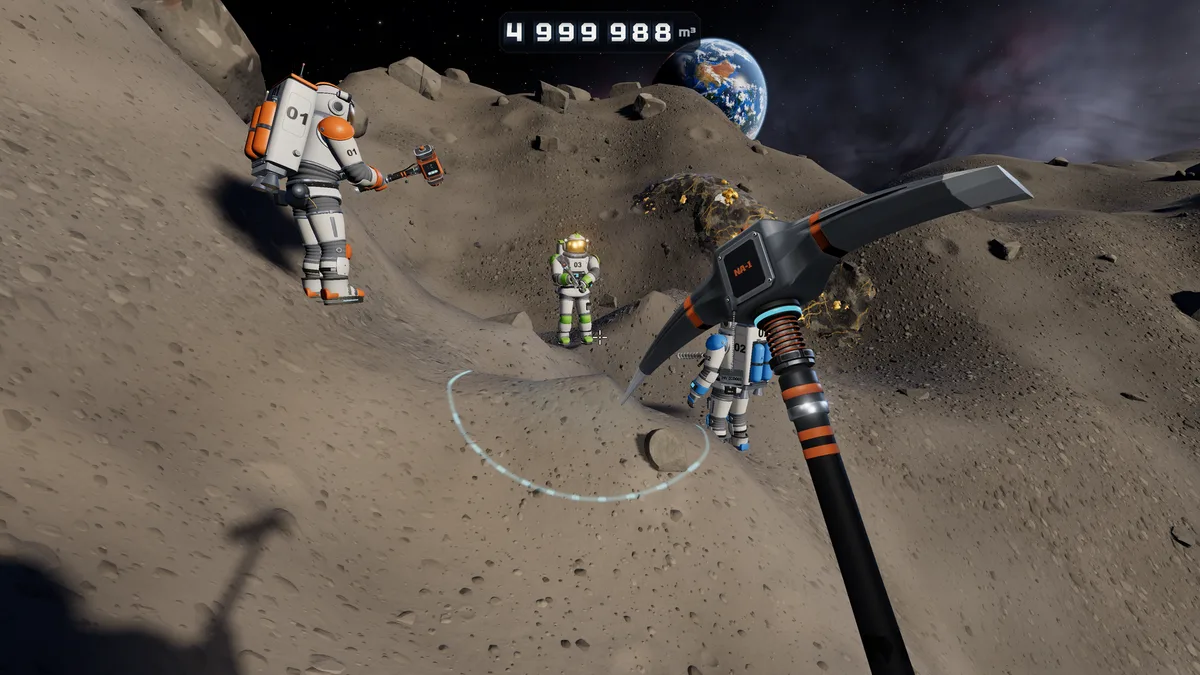
The host’s save is the crew’s save. If the host is not playing, the campaign does not progress, and every upgrade the crew buys belongs to that host’s run. That is the first thing to agree on before anyone invests a weekend: whose campaign is this?
Who controls the money?
The host controls spending from the shared ore wallet. Everyone digs, everyone’s ore goes into the same pool, and the host decides what the pool buys. Since 1.0.1 the host can also allow personal loadouts, which let individual players buy their own gear at solo prices rather than drawing on the shared wallet.
That option is the answer to the most common co-op argument. A crew that wants to play together casually can leave personal loadouts off and treat the wallet as a team budget. A crew with mixed experience can turn them on so a veteran can buy their own tools without spending the beginner’s air upgrade money.
| Decision | Who makes it | Notes |
|---|---|---|
| What the shared wallet buys | Host | Host-controlled since launch, personal loadouts added in 1.0.1 |
| Whether personal loadouts are allowed | Host | Personal gear uses solo prices |
| When the lander launches | Any seated player | Starts a 10-second countdown |
| Who is on the crew | Host | Host can kick, and since 1.0.5 can allow rejoin |
| Which save progresses | Host | Guests keep their own separate game |
| Achievements | Shared | Guests can earn them; fixed for guests in 1.0.3 |
What does co-op cost you?
Two official penalties. First, ore sales pay 90% after multiplayer shifts, so every haul is worth a tenth less than the same haul solo. Second, the Laser, Plasma Cutter and Missile Swarm cost 50% more for two-player crews and 100% more for three or more, a change added in 1.0.4.
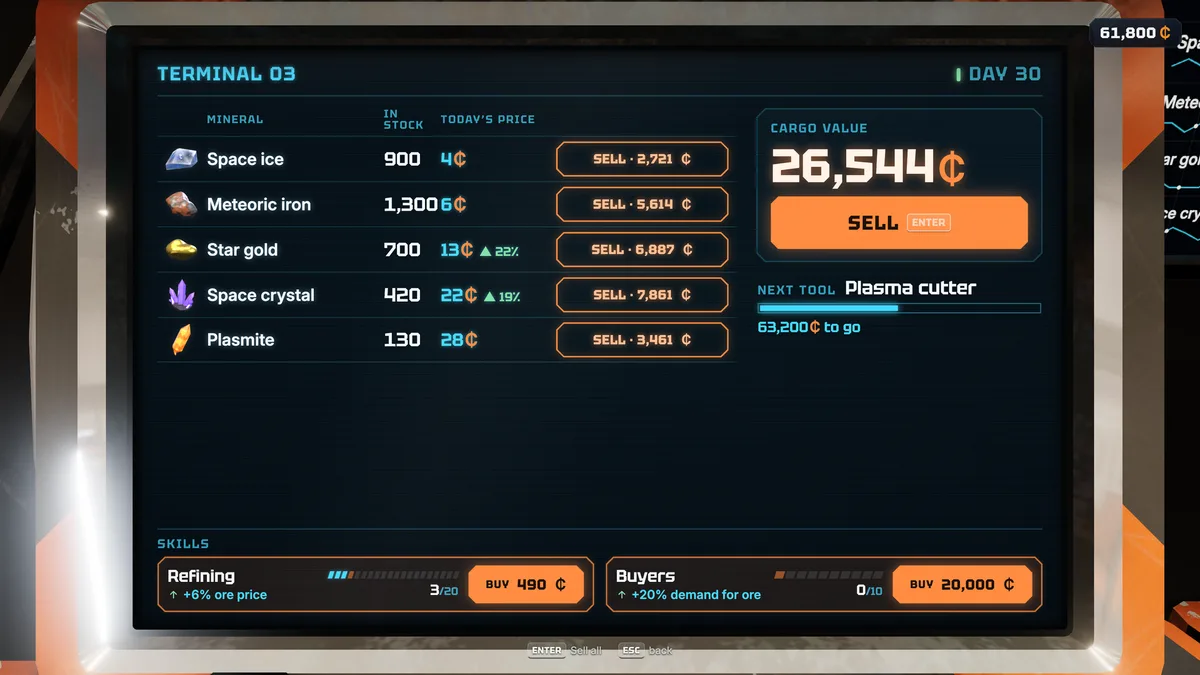
| Crew size | Ore sale value | Laser, Plasma Cutter, Missile Swarm | What it means |
|---|---|---|---|
| Solo | 100% | Solo price | The baseline |
| 2 players | 90% | +50% | Duo is the cheapest way to play with a friend |
| 3 or more | 90% | +100% | Volume has to make up the price gap |
The effect is to keep eight players on one asteroid from brute-forcing the ninety-day contract: a large crew earns less per unit and pays more for its late tools. The practical response is to lean on shared volume and cheap guns rather than have everyone buy late tools. The ship weapons guide explains which guns add passive volume for the money.
How dangerous is the launch countdown?
It is the most dangerous mechanic in co-op, and it is entirely social. Anyone seated in the lander can start a 10-second launch countdown. Anyone still outside when it finishes blacks out and loses their cargo, and the day is spent for the whole crew.
Because any seated player can start it, the counter-rule is a headcount: nobody starts a countdown until every player has called in. If you are running with voice chat, say “two minutes” when you are starting your last cut; if you are on text, use the T chat added in 1.0.1. The air and oxygen guide explains why a crewmate at a quarter bar needs the countdown called early rather than late.
What do guests keep between sessions?
Their own game, their own achievements and their own drones. Guests keep a separate solo save, achievements are shared and earnable by guests (fixed in 1.0.3), and since 1.0.1 every guest has their own drones rather than sharing the host’s. Personal loadouts, if the host allows them, are bought at solo prices rather than from the shared wallet.
What guests do not keep is the campaign. The asteroid, upgrades, wallet and day counter belong to the host’s save. If the host stops playing, the crew’s progress stops with them.
Can bots fill the crew?
Yes. Bots can fill empty crew slots, added in 1.0.1 and fixed further in 1.0.6. They are useful for testing a co-op strategy or for keeping a small crew’s volume up when someone cannot make a session, but they do not replace a player’s judgement about the countdown or the wallet. Treat a bot-filled crew as a solo run with extra guns, not as a real co-op session.
How do you talk to your crew?
Text chat is on T, added in 1.0.1. Voice supports open mic and push-to-mute, added in 1.0.5, and teammate markers arrived in 1.0.8 so you can find each other on the rock. The markers matter more than they sound: a common co-op blackout is two players working opposite faces, neither knowing the other is deep.
Are there co-op leaderboards?
Yes, since 1.0.9. Leaderboards track co-op completion in crews of two to four and crews of five to eight, alongside solo completion day and time, best solo mining shift and arcade games. That split is a useful hint about crew size: a duo and a full crew are different challenges, not the same one with more people.
What crew rules prevent lost hauls?
Five rules cover almost every co-op disaster. Agree them before the first launch, because they only work if everyone follows them without being reminded.
- No countdown without a headcount. The launch is the only mechanic that can take a crewmate’s cargo without their input.
- Call your air at a quarter bar. The crew can slow down or send someone back, but only if they know.
- Decide the wallet spend before the shift, not after. The host controls the money; arguments after a sale cost more time than the purchase saves.
- One player owns the daily order call. Two players chasing different orders split the crew’s volume for no bonus.
- Park personal loadout decisions before day one. Retrofitting the rule mid-run causes the argument the option was meant to prevent.
Is co-op harder than solo?
It is harder to organise and easier to dig. The 90% sale value and the tool price penalties mean a crew earns less per unit of ore, but eight players with their own drones and guns remove volume far faster than one. The failure mode is not the economy; it is the countdown and the wallet. A crew that talks can finish faster than a solo run. A crew that does not talk loses days to blackouts and arguments.
If you are new to the game, play the first few days solo with the beginner guide, then bring friends in once you understand the loop. The host should also understand the day economy before committing a crew to a campaign, because a shared run has no spare days for a bad launch. For the changes that shaped co-op — personal loadouts, rejoin, voice, leaderboards — the patch notes list every version. And if you are weighing whether the multiplayer friction is worth it at all, the how long to beat breakdown compares a solo run with a crew run in real hours.
Gallery
FAQ
How many players can play No Asteroids co-op?
Who controls the money in No Asteroids co-op?
Why does ore sell for less in No Asteroids co-op?
Can you kick players in No Asteroids co-op?
Related Articles
mining
No Asteroids Mining Routes: How to Dig and Get Back
A practical No Asteroids mining route: plan the exit first, spiral instead of sinking a shaft, watch the one-third air rule, and know when to tether home.
guides
No Asteroids 90 Days Guide: How the Clock Really Works
How the No Asteroids 90-day contract works: what the counter measures, which actions spend a day, a ten-day spending plan and how to fix a run that is behind.
guides
No Asteroids Air and Oxygen: How to Never Black Out
How the No Asteroids air bar works, what a blackout costs, when to turn back, what the ampoule is worth and how the jetpack and tether keep you alive.
Was this helpful?
Thanks for the feedback!